Becoming an O|Zone Developer Partner
Every ScanPod and ScanPort site begins with land. That’s where the developer group comes in. Whether it’s an individual with local development experience, a regional partnership, or a construction consortium, these are the people who identify, prepare, and deliver the ground-ready locations where each ScanPod will live.
1. The Role of the Developer
The developer’s job is to take a raw piece of land—often within a Qualified Opportunity Zone—and transform it into a fully prepared site capable of supporting a ScanPod™ or an entire ScanPort.
That means:
Acquiring or controlling the land, often with the landowner as a joint participant.
Managing site preparation: grading, roads, parking, drainage, water, sewer, electrical, and broadband conduits, as well as facilitating installation of applicable geothermal well and systems.
Constructing the certified ScanPad foundations that the modular Companion Container Sets will mount to.
Each ScanPad can be built directly on grade or above a bunker or basement structure, depending on site conditions or design requirements. These sub-structures can house mechanical systems, shielded power nodes, or entropy recovery hardware—all connected upward into the GreenBox containers that form each ScanPod. Emergency provisions may be included as well.
2. Private-Sector Development, Public-Sector Ownership
All of this early work—the site acquisition, design, and construction—is done privately by a developer. That’s deliberate. It avoids the time, cost, and constraints of public-sector bidding during the build-out phase and keeps local control in the hands of experienced professionals.
Once the site is complete, the developer sells the finished property to the O|Zone Government Authority—a special-purpose authority established by the county as part of the broader O|Zone Initiative.
The purchase is funded through tax-exempt municipal revenue bonds issued by that authority. These bonds are non-recourse to the county and are secured solely by the revenue streams associated with the ScanPort™ infrastructure.
3. The Lease-Back Framework
Immediately following the sale, a master lessee, which may comprise or include an individual(s) associated with the developer, leases the site from the authority. The lease term is 20 years, fully prepaid at closing, with multiple renewal options extending up to 99 years.
This structure provides:
• master lessee with a tax-advantaged synthetic bond-like position, effectively capturing the long-term value of a municipal lease,
• potentially reduces the amount of long term debt Government Authority must issue for acquisition or
• provides authority with an upfront capital inflow from the prepaid lease, strengthening its position to finance additional infrastructure, establish reserve funds, and/or support initial operating costs.
This creates a public–private alignment where the master lessee holds long-term operational control and revenue participation, while the governmental authority retains title and statutory bond status.
4. Why It Matters
For counties, this model delivers ready-to-use infrastructure without taxpayer funding. For developers and master lessee, it offers a repeatable, scalable business: acquire land → prepare sites → sell to authority → lease back → participate in the ongoing revenue from ScanPod and other operations.
Because each ScanPort™ site is built within the O|Zone framework, the developer and master lessee may benefit from Qualified Opportunity Zone treatment, local economic incentives, and access to the HGVS national platform of ScanPod deployment opportunities.
5. The Financial Foundation
This lease-sale-leaseback framework is more than a transaction—it’s the foundation of the ScanPort and other O|Zone ecosystems. It ensures that every site is privately executed, publicly owned, bond-financed, and sustainably operated.
It gives developers and master lessees a way to build permanent, income-producing assets while delivering essential infrastructure that supports healthcare access, research innovation, and community economic renewal—all within the O|Zone bond and trust structure.
There are lots of different ways a Human can participate in Development. But to make this easier to follow, let’s use a ScanPod™ as our example and follow one Human who owns both the Developer and the Master Lessee. They’re separate businesses doing different things, but using the same Human lets follow what happens from developing the land, through the sale of the completed Site to a Government Authority, and into what happens next.Along the way, we’ll also begin to see how one Development can create capital and opportunities that can continue to grow well beyond the original Development.
The Developer is responsible for acquiring or controlling the land, preparing and developing the Site, and delivering the completed Site for sale to the appropriate local Government Authority. The Developer works with traditional development and construction professionals, together with LAUNCH [LABS], the Project Steward, Integration Steward and Technical Steward, to create the physical Site and infrastructure required for the Opportunity.
Developing the Site
The Developer begins with the geography. The land may already be owned or controlled by the Developer, acquired for the Development, or developed in partnership with an existing landowner. From there, the Developer assembles the professional, technical and financial resources necessary to transform the property into a completed Site.
That work can involve land acquisition and due diligence; surveying and civil engineering; planning, permitting and site design; grading, drainage and stormwater management; streets, entrances, parking and circulation; water and wastewater; electrical service and distributed energy infrastructure; communications and broadband; geothermal wells and related systems; landscaping and other Site improvements; and the foundations, GreenPads™ and utility interfaces required by the facilities that will occupy the Site.
The Developer does not need to perform each of these functions directly. Its role is to facilitate the Development—bringing together the landowner, engineers, architects, contractors, utilities, governmental infrastructure providers, financing sources and other professionals required to deliver the Site.
At the same time, the Developer works with LAUNCH [LABS], the Project Steward, Integration Steward and Technical Steward so that the Site is being developed around the actual requirements of the Opportunity rather than simply preparing generic real estate. For a ScanPod™, for example, that can include the location and configuration of the ScanPad™, subsurface infrastructure, GreenPad™ interfaces, equipment and utility requirements, emergency access, communications, energy systems and the physical pathways through which the modular facility will be installed and operated.
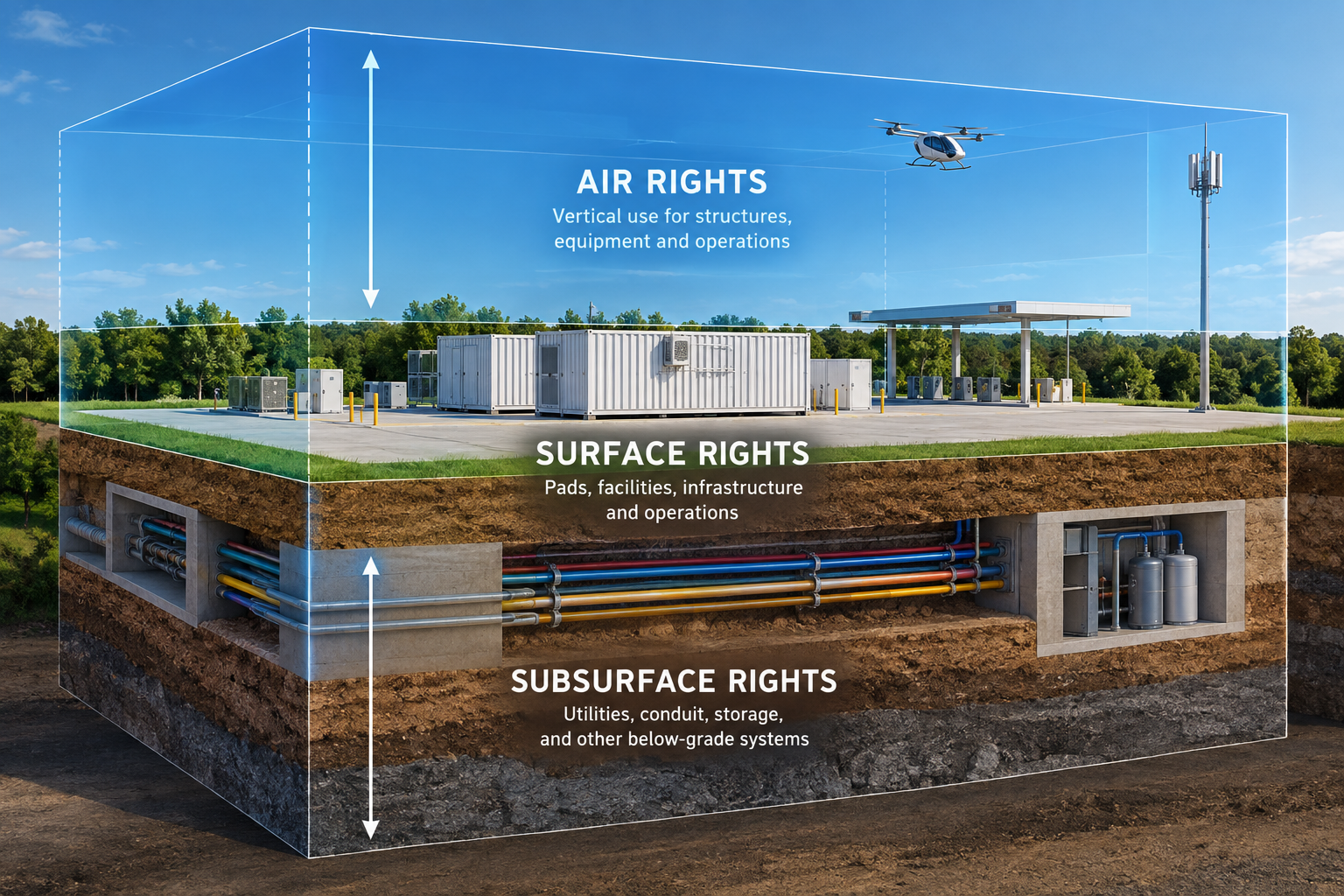
Development can extend below, across and above the surface. Subsurface infrastructure may include utilities, conduit, geothermal systems, storage, foundations, storm shelters, emergency storage, bunkers or other below-grade capabilities. Surface Development can include Pads, facilities, roads, parking, utilities and operating infrastructure. Air rights can provide additional capacity for structures, communications, equipment and other uses appropriate to the Site.
The result is more than prepared land. The Developer delivers a functional Site capable of receiving and supporting the facilities, equipment, infrastructure and operations for which it has been developed.
Development Below the Surface
A Site does not end at ground level. In this ScanPod™ example, subsurface Development can become part of the infrastructure supporting the modular facilities above—providing space for utilities and mechanical systems, protected infrastructure, storage, emergency provisions, and a basement, bunker or storm shelter configured for the needs of the Site and community.
Press the video below and watch the five Companion Container Sets move away. What remains reveals another part of the Developer’s work: the below-grade Site infrastructure upon which the ScanPod™ is built.
Above that permanent foundation, GreenPads™ provide the engineered interface between the Site and the ISO container building blocks, allowing the modular facilities above to remain configurable and redeployable as needs evolve.
Above that permanent foundation, GreenPads™ provide the engineered interface between the Site and the ISO container building blocks, allowing the modular facilities above to remain configurable and redeployable as needs evolve.
From Site to Pod
The Developer’s work prepares the Site for what comes next. The permanent Site infrastructure—surface and subsurface systems, foundations and other supporting improvements—is configured so that GreenPads™ can connect the Site to the modular building blocks.
In our ScanPod™ example, the GreenPads provide the interface upon which the Companion Container Sets are assembled into the completed facility. Other O|Zone™ Opportunities may use different Pod configurations, but the principle remains the same: the Developer prepares the Site and its infrastructure; the Opportunity brings the facilities and activities the Site is being developed to support.
Press the video below to explore a ScanPod™ and see what can be built above the Site.
A note as you explore: Some of the material you encounter may look familiar. These linked sites explore different aspects of a common architecture, so videos, equipment, technologies and examples sometimes appear in more than one place. The repetition is intentional, allowing each site to provide enough context to be explored independently.
O|Zone™ brings together private-sector Development with a longer-term governmental perspective on land, infrastructure and quality of life. Within each participating county, a specialized Government Authority provides a governmental home for land and Sites developed within the O|Zone framework—enabling the county to look beyond an individual project toward the long-term use, stewardship and productive capacity of its geography.
For an O|Zone Opportunity such as our ScanPod™ example, the Developer develops the Site through private-sector development processes, coordinating the land, civil engineering, infrastructure, foundations and other improvements required by the Project. The Developer and Project Steward also coordinate with the county’s specialized governmental functions for energy and power, water and waste, communications, emergency services and public spaces, helping the Development incorporate infrastructure and digital-transformation capabilities consistent with the county’s longer-term objectives.
Those specialized governmental functions do not necessarily replace existing utilities, municipalities, service providers or private participants. Instead, they provide a countywide perspective from which new Developments can help advance digital transformation. Sensors, controls, communications systems and other technologies may be provided by private equipment participants while being coordinated with each applicable Government Authority—creating additional opportunities to understand infrastructure use and condition, improve interoperability, reduce costs and expand the information available for future county planning and operations.
A separate Digital Tariff Authority facilitates the information and financial flows associated with O|Zone Opportunities, providing another digital layer through which participating Sites, infrastructure and activities can interoperate within the larger O|Zone ecosystem.
Once the Site has been completed, the land-focused Government Authority can acquire the developed Site from the Developer, moving the underlying geography into long-term governmental ownership while enabling the value created through private Development to be realized. The acquisition is anticipated to be financed through tax-exempt municipal revenue bonds, creating a bridge between private Development and long-duration public infrastructure. Those obligations may also be supported in the secondary market through credit enhancement provided by participating LAUNCH [OK] Insygne™ IAC insurers, connecting the Development to another part of the LAUNCH [OK] financial ecosystem.
Governmental ownership, however, is not intended to end productive private use of the Site. Following acquisition, the Government Authority expects to enter into a long-term lease with a Master Lessee, with an initial lease period paid in advance. That prepaid initial term provides cash flow to the Government Authority at the beginning of the relationship while establishing the long-duration private-use framework through which the Site can continue supporting O|Zone Opportunities. The private use component is designed to be within applicable regulatory guidelines, providing the public sector an increase in public use lands.
Once the completed Site has been acquired by a Government Authority, the Master Lessee enters into a long-term lease for the Site, with an initial lease period paid in advance and continuation rights that can extend the relationship for as much as 99 years.
The Master Lessee does not acquire the Site in order to sublease pieces of the land to others. It uses the Site as the foundation of its own Site-use business, providing the physical and operating environment through which O|Zone™ Opportunities can locate, connect and conduct activities at the Site.
That environment can include GreenPads™, energy and power, communications, water and waste interfaces, security, emergency-services connectivity, access and circulation, and other Site infrastructure and capabilities required by the Opportunities operating there.
Within that environment, the Digital Tariff Authority establishes governmental tariffs governing defined activities and economic rights associated with the Site and the Opportunities operating through it. Through those tariffs, economic participation can be allocated among the Master Lessee and other parties whose land, infrastructure, equipment, services and other capabilities contribute to the activity occurring through the Opportunity.
Over time, the Master Lessee’s long-duration relationship with the Site takes on the character of stewardship—maintaining and evolving the Site capability as facilities, equipment, technologies and Opportunities change through successive generations.
The geography may change, and the structure may change with it. But in each case, Development can create new capital and long-duration Site capacity that can be put back to work supporting the Opportunities that follow.
A Site-use agreement can connect the Master Lessee’s Land | Pad position to one or more O|Zone™ Opportunities using the Site. That relationship does not have to be limited to a fixed charge for physical space. Depending upon the arrangement, the Master Lessee’s participation can include an economic interest associated with the revenue and value appreciation generated through O|Zone Opportunities connected to that Site use.
The scale of an O|Zone Opportunity is not fixed. A container, Companion Container Set or larger configuration can itself comprise an O|Zone Opportunity, while hundreds or even thousands of additional O|Zone Opportunities can operate within the same physical environment. Each can bring together its own combination of Land | Pad, facility, equipment and intangibles, inventory and operating capability within the Digital Tariff Authority framework.
No one can know how those activities will be configured decades from now. Facilities will change. Equipment and technologies will change. Entirely new activities will emerge. What can endure is the Master Lessee’s long-duration control of the Site and the Site-use relationships through which successive O|Zone Opportunities connect to that geography.
The value of the Master Lessee’s position therefore does not depend solely upon what is built on the Site today. It can participate in what that Site becomes.

Different Humans. Different Ways to Participate.
We have simplified this Development by following a Human who participates through both the Developer and Master Lessee. That pathway can begin with the value created through Development and continue through long-duration control of the Site, Site-use agreements and participation in the revenue and value appreciation associated with O|Zone™ Opportunities that use the Site.
But that is only one way a Human can participate.
A Human can bring capital, land, facilities, equipment, inventory, technology, intellectual property, professional capability, relationships, experience, time or an idea. A Human can create an O|Zone Opportunity, operate one, invest in one, or provide one of the assets or capabilities it needs. A Human may also establish, invest in or participate through LAUNCH [LABS], a Project Steward, Integration Steward or Technical Steward, bringing innovation and specialized capabilities into Opportunities as they develop.
For high-income Humans, ownership of productive equipment can provide another pathway. Applicable tax deductions, credits and other incentives can create Self-Directed Incentive Capacity (SDIC)—the capacity to redirect a portion of money that otherwise would have been paid as taxes toward acquiring and deploying productive assets. Those assets can then participate in the Equipment position of O|Zone Opportunities while supporting the facilities, services and activities being developed within participating communities.
At a larger scale, Humans may lead or participate in organizations capable of providing banking, insurance, institutional investment or other financial capacity. Some organizations may be positioned to participate through FlexGIA, helping provide the financial capacity enabliing the launch of LAUNCH [OK] and supporting Opportunities and Developments that follow.
Participation does not have to begin with money. Accountants, attorneys, physicians, engineers, architects, contractors, technologists, researchers and other professionals can participate through their knowledge and professional capabilities. Innovators can bring technologies and ideas through LAUNCH [LABS]. Local participants can recognize needs and create new O|Zone Opportunities around them. Others can contribute relationships, leadership, operating experience or the ability to bring people and resources together.
There is no single Human participation model. A Human can participate with what they already have, where their interests and capabilities fit, and in more than one part of the ecosystem at the same time.
One Example: Equipment, SDIC and ScanKids™
Equipment ownership illustrates how participation can create value at more than one point in an asset’s life. At acquisition, applicable incentives can create Initial Self-Directed Incentive Capacity, helping offset the cost of placing new productive equipment into service.
At the end of the owner’s planned equipment lifecycle, the equipment can potentially be gifted to ScanKids™, the nonprofit initiative advancing pediatrics. The gift can create additional incentive capacity for the donor, while ScanKids can refurbish the equipment for another productive life and subsequently sell it, converting remaining equipment value into cash funding for its pediatric mission.
Gift → Refurbishment → Resale can therefore extend the productive life of equipment while creating a recurring pathway through which equipment value can help fund ScanKids™ and the advancement of pediatrics.
BUILD LOCALLY. BEGIN WHERE OPPORTUNITY EXISTS.
Individually and together, the foregoing foundational O|Zone™ Ecosystems provide communities, counties and participating PAOZ regions with infrastructure, connectivity and operating capabilities that can support an expanding range of Initiative Ecosystems and Opportunities. They need not be introduced first, together, or in any prescribed sequence. Communities may begin with the Opportunities and capabilities most relevant to them, then connect, adapt and expand as local participation and needs evolve.
But turning Opportunity into continuing operation takes more than a framework. It takes people and organizations willing to bring experience, capabilities and resources together—and remain engaged as what has been created evolves.